

Why HIV Is Spreading Faster in Pakistan—Who Is Most at Risk?
Shazia Mehboob
Islamabad: In the heart of Islamabad, a quiet but alarming trend is unfolding, one that public health experts warn can no longer be ignored.
According to official statistics, from January 2025 to March 2026, 618 new HIV cases have been reported in the capital alone. That translates to more than 41 new infections every month, underscoring a steady and dangerous rise in the spread of HIV/AIDS.
What makes this surge particularly concerning is who it is affecting most.
A Youth-Centric Crisis
Official data reveals that young men are at the center of this outbreak. Of the 618 reported cases, 397 are adult men, accounting for nearly 64 percent. Women make up 106 cases, while 93 cases have been recorded among transgender individuals, and 22 among children.
Health experts point to a troubling pattern: risky behavior linked to drug use. The use of crystal meth, commonly known as “ice,” has emerged as a key driver.
Under its influence, individuals are more likely to engage in unprotected sex, significantly increasing the risk of transmission.
This intersection of substance abuse and unsafe sexual practices is accelerating the spread at a pace that traditional awareness campaigns are struggling to contain.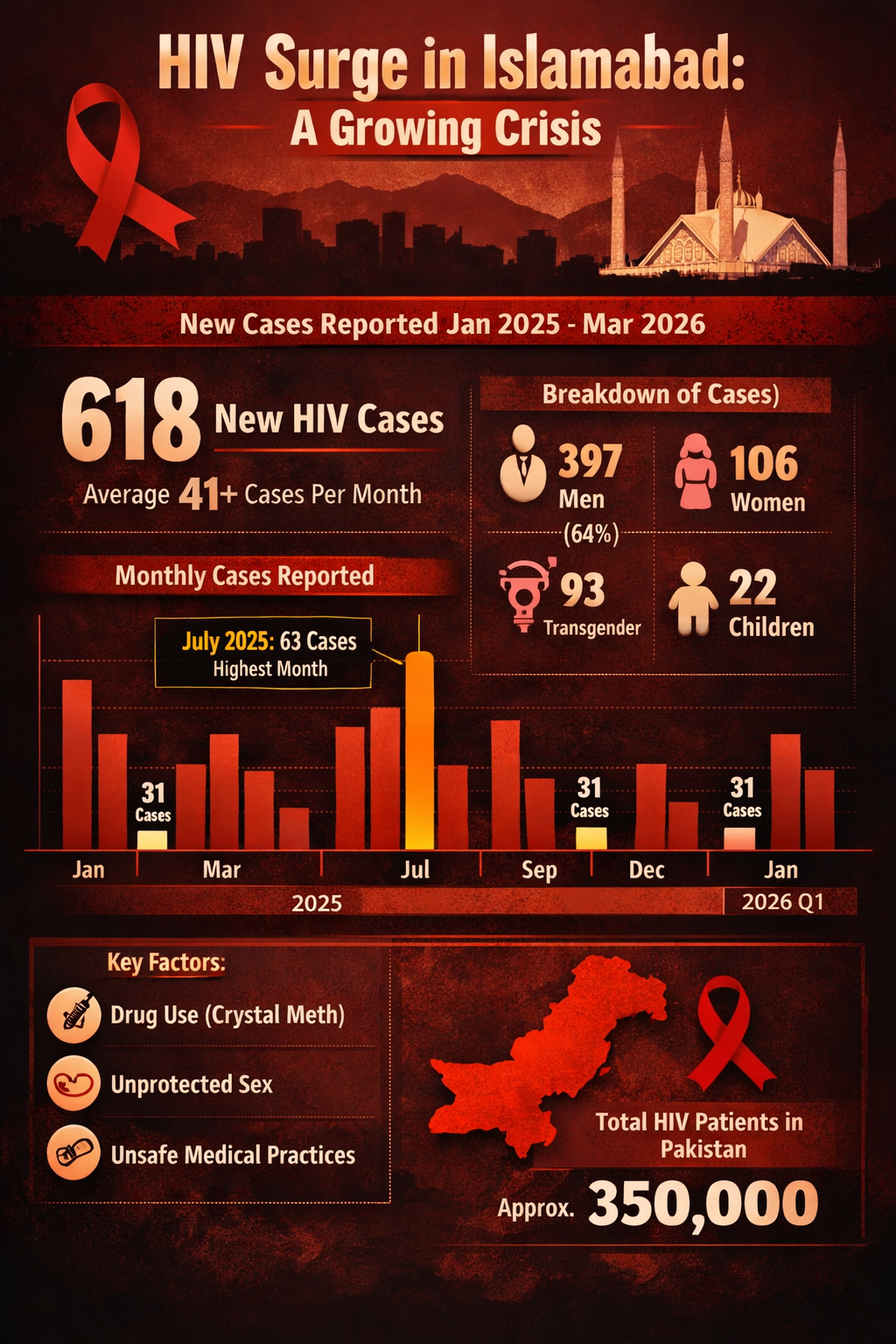 A Nationwide Concern
The situation in Islamabad mirrors a broader national challenge. Across Pakistan, the number of people living with HIV is estimated to have reached around 350,000, marking what experts describe as a growing public health crisis.
Former federal health minister Zafar Mirza has raised serious concerns, warning that the disease is entering a more dangerous phase in the country.
According to him, the causes extend beyond behavioral risks.
Systemic Gaps Fueling the Spread
Unsafe medical practices remain a critical factor. The reuse of contaminated syringes and inadequate screening of blood before transfusions continue to expose thousands to infection.
“These are preventable causes,” experts stress, pointing to systemic weaknesses in healthcare delivery and regulation.
Even more alarming is the rising number of HIV cases among children, a sign that transmission is not limited to high-risk groups but is seeping into the general population through unsafe medical procedures.
Warning Signs for the Health System
Dr. Mirza notes that the upward trend in HIV, and other infectious diseases like hepatitis, reflects deeper structural issues within Pakistan’s healthcare system. Weak oversight, inconsistent safety protocols, and gaps in public awareness are compounding the crisis.
He emphasizes that mandatory screening of blood and strict regulation of medical practices are essential steps to contain the spread.
Beyond Statistics
While the numbers are stark, the real challenge lies in shifting behavior, strengthening institutions, and addressing stigma. HIV remains a deeply sensitive issue in Pakistan, often underreported and misunderstood, which further complicates prevention efforts.
As the virus spreads silently, the question is no longer whether Pakistan is facing an HIV crisis, but how quickly it can respond before the numbers escalate further.
The warning signs are clear. What remains uncertain is how urgently they will be acted upon.

Comments are closed.