

Sidhnai Headworks and 2025 Flood: What Went Wrong?
Faisal Saleem
Khanewal: During August and September 2025, the River Ravi overflowed its banks, inundating vast areas of Abdul Hakeem, Kot Islam, and surrounding localities in Punjab’s Khanewal district. Thousands of acres of farmland, villages, roads, fish farms, and public infrastructure were submerged, leaving behind widespread destruction and heavy economic losses.
Even after the floodwaters receded, one question continues to trouble the people of the affected areas: If the Nikaso spill channel was built decades ago to carry away excess floodwater and protect nearby communities, why didn’t the 2025 floodwaters flow through it?
The question has fueled debate among local residents, engineers, and flood experts, raising broader concerns about the condition, maintenance, and effectiveness of Pakistan’s flood management infrastructure.
Was the spill channel no longer capable of performing its intended role, or were there other factors that rendered it ineffective when it was needed most?
The fish farms spread across 6,000 acres in Nikaso are a vital part of Pakistan’s fisheries industry. However, they were devastated by the floods.
According to Muhammad Zafar, a member of the Fish Farmers Association Nikaso, timely and effective flood control measures could have protected these farms and prevented losses worth millions of rupees.
Climate Change Meets an Ageing Flood System
According to a recent advisory issued by the National Disaster Management Authority (NDMA), climate change is not limited to rising temperatures; it is also altering rainfall patterns and increasing the intensity of rains.
A warmer atmosphere can hold more moisture, increasing the chances of intense rainfall over shorter periods. Unusually high temperatures in northern Pakistan accelerate glacier melt, while this additional water combines with monsoon rains to further increase river flows.
Consequently, in recent years Pakistan has faced floods in which heavy rainfall, glacier melt, human construction on natural floodplains, and obstructions to natural river flows collectively intensify the scale of destruction.
The old Sidhnai Headworks, constructed in 1886, came under increasing pressure from major floods in the River Ravi over time, compelling the government of that period to establish an alternative flood diversion system.
For this purpose, the Sidhnai Spill Channel (Nikaso) was constructed in 1959. It was designed with a capacity of 30,000 cusecs, although in practice it was excavated to accommodate only around 20,000 cusecs.
Later, under the Indus Basin Replacement Works, the new Sidhnai Headworks was constructed approximately 11 kilometers upstream of the old weir.
During this project, only the spill channel’s head regulator was upgraded to a capacity of 45,000 cusecs, while the remainder of the channel was neither widened, rehabilitated, nor re-excavated.
According to the official Flood Fighting Plan, this is the reason why, since the construction of the new Headworks, the spill channel has never received water according to its original design capacity, not even during the most severe floods.
The same question resurfaced after the 2025 floods.
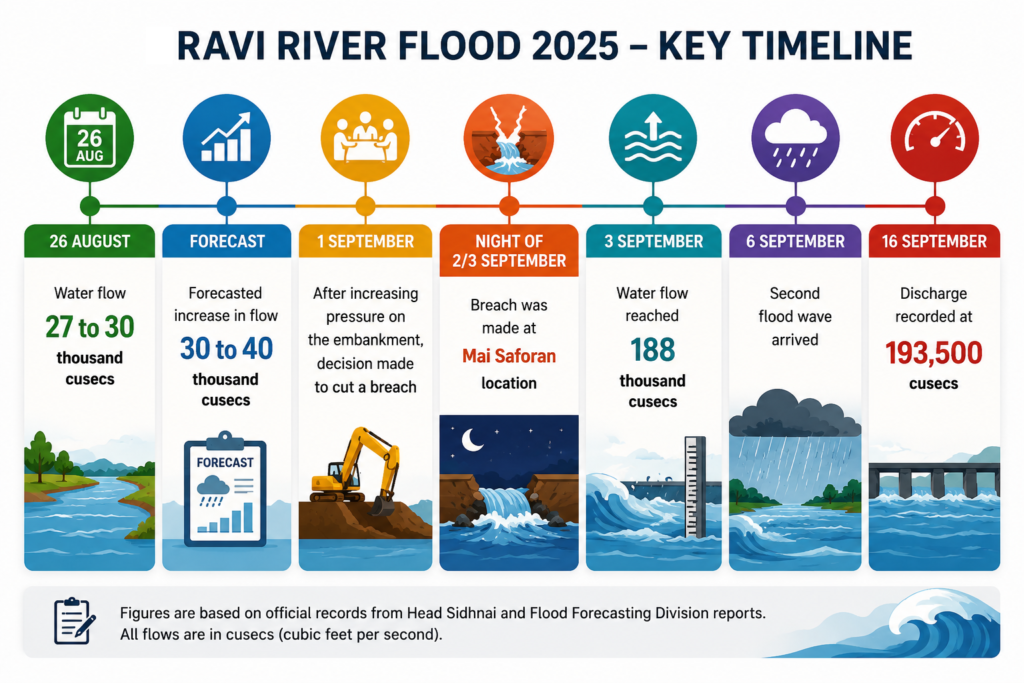
According to information obtained from the District Administration Khanewal, on 3 September 2025, a discharge of 188,000 cusecs was recorded at Sidhnai Headworks, while its approved discharge capacity is approximately 150,000 cusecs.
How 2025 Ravi Flood Unfolded
The scale of the destruction raised a critical question: Did the 2025 Ravi flood expose weaknesses in a flood management system that millions of people living along the River Ravi still depend on?
Throughout August 2025: According to official records from Sidhnai Headworks, the River Ravi experienced low- to medium-level flooding for most of August. However, during the final week of the month, water pressure at Sidhnai Headworks increased steadily.
1 September 2025: With pressure continuing to build, the relevant authorities decided to make controlled breaches at Mai Saforan to protect the embankment and reduce the risk of a larger failure.
Night of 2–3 September 2025: A controlled breach was made in the embankment at Mai Saforan, near RD 16. The site is located about 200 feet to the right of the Nikaso spill channel, which was originally constructed to divert excess floodwater from Sidhnai Headworks. Following the breach, floodwater spread rapidly into nearby settlements.
Following 48 Hours: Official records state that water levels began to recede about 48 hours after the breach.
Night of 6 September 2025: A fresh flood wave, combined with additional monsoon rainfall, intensified the flooding once again, worsening conditions in the affected areas.
The flooding affected 160 mouzas in District Khanewal and inundated 129,508 acres of agricultural and non-agricultural land, causing widespread damage to homes, farmland, roads, fish farms, and other infrastructure.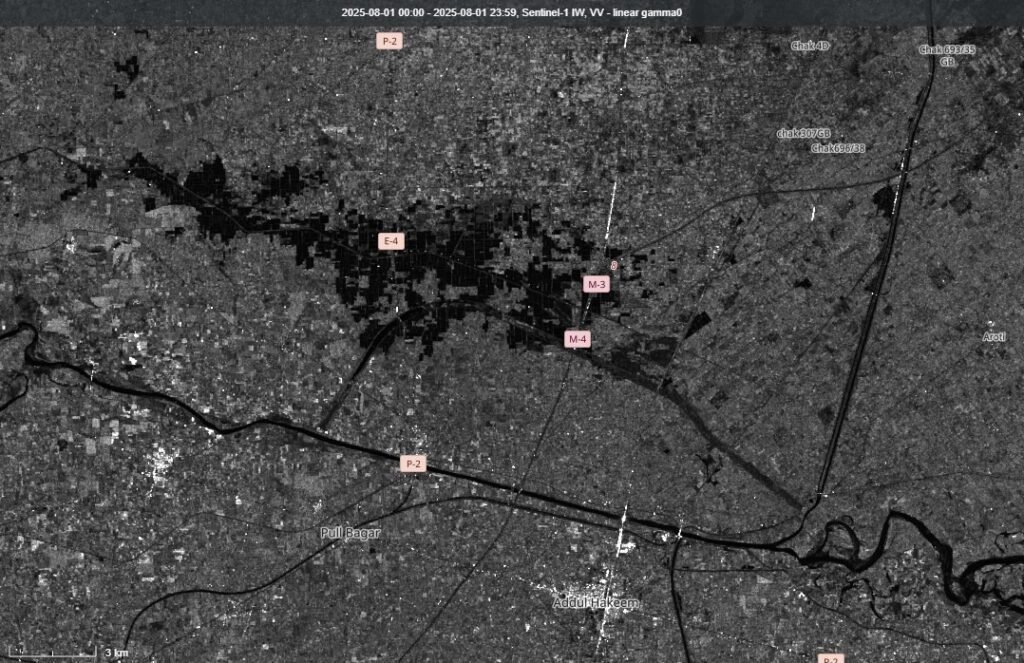 Voices from the Flood Zone
According to Muhammad Asad, Sub-Engineer at Sidhnai Headworks, flood warnings were issued nearly two weeks in advance for Sidhnai Headworks, settlements along the River Ravi, and areas where embankments were considered vulnerable. As a result, most residents were evacuated before the flood reached them.
“Our priority was to avoid breaching the embankments,” Asad said. “But when floodwater started moving towards Abdul Hakeem, Kot Islam, Sarai Sidhu, Shahadat Kandhla, and Bagar Sargana, we had no option but to make a controlled breach late at night to reduce the pressure.”
For local residents, however, the flood’s impact extended far beyond the immediate danger.
Resident journalist Safdar Sial said the floodwater travelled nearly 40 kilometres from east to west, passing through Mai Saforan before eventually joining the River Chenab. At the same time, the area stretching from Kot Islam to Pul 25, around 20 kilometres from north to south, remained submerged for weeks.
The flooding brought transport to a standstill. According to Sial, traffic on the National Highway remained suspended for several days, while railway services between Khanewal and Faisalabad were disrupted for more than two months.
Social activist Shehzad Francis recalled that water flowed over the bridge at the old Sidhnai Headworks near Kot Islam. He said the entire belt from Mouza Doana towards Shorkot, up to Pul 25, remained underwater, leaving villages isolated and causing widespread hardship.
The economic losses were equally severe.
According to Muhammad Zafar, a member of the Fish Farmers Association Nikaso East, more than 300 fish farmers operate around the Nikaso, with farms ranging from one to fourteen acres. He estimated that operating a one-acre fish farm costs about Rs500,000 and generates returns of around Rs800,000.
Based on these figures, he said fish farmers suffered investment losses of nearly Rs3 billion. He also claimed that no government compensation was provided. Before the floods, fish farming covered nearly 6,000 acres in the area; today, he said, it has shrunk to barely 2,000 acres.
Residents say the flood’s impact lingered long after the water began to recede.
Afzal, a resident of Palo Treli, said floodwater remained in his area for nearly one and a half months, and even today ponds left behind by the flood can still be seen at several locations. During that period, homes were accessible only by boat, children were unable to attend school for two months, and many families, including his own, had to rebuild homes and businesses destroyed by the flood.
The questions raised by the 2025 floods are not entirely new. The Flood Fighting Plan 2023 prepared by the Irrigation Department acknowledges that during previous major floods, the Nikaso spill channel has never carried water according to its original design capacity.
That admission has renewed concerns over whether one of the region’s key flood-control structures is still capable of performing the role for which it was built.
Why Didn’t the Spill Channel Work?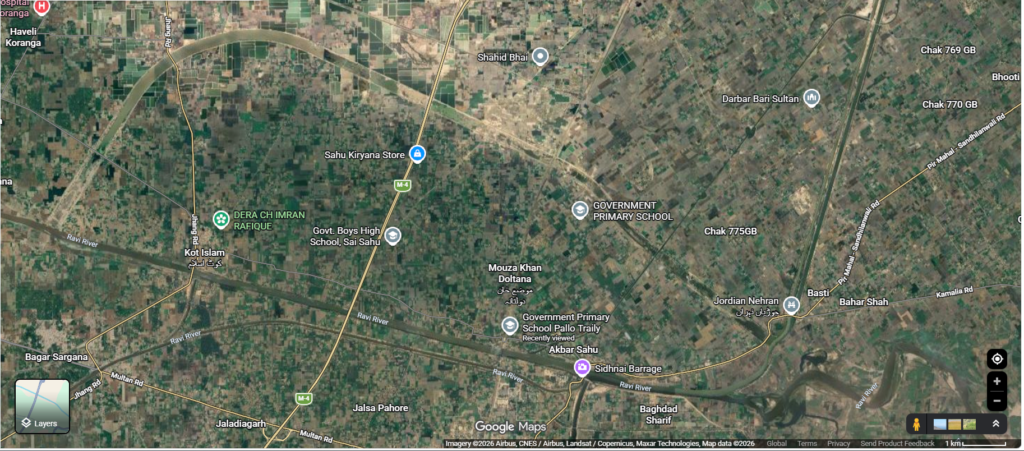 Official documents point to several reasons why the Nikaso spill channel did not function as intended during major floods.
The first is its limited carrying capacity, which officials acknowledge is insufficient to accommodate high flood flows.
The second is the presence of a nearly seven-kilometre railway embankment between the railway bridge crossing the Nikaso and Kot Islam. Rising about 14 feet high, the embankment lacks an effective drainage system, restricting the movement of floodwater.
A third challenge emerged with the later construction of the M-3 and M-4 motorways. According to official records, their embankments, which rise more than 20 feet, have further obstructed the natural flow of floodwater across the area.
District Administration documents also acknowledge that the 2025 flood largely followed its historic natural course before eventually joining the River Chenab. Along that route, however, a series of human-made structures continued to impede the movement of floodwater, increasing pressure on surrounding areas.
While these documents identify the obstacles, they stop short of answering the question many residents continue to ask: What practical steps will be taken to restore the Nikaso spill channel so it can function effectively during future floods? So far, the official records provide no clear roadmap for achieving that goal.
Can Flood System Be Strengthened?
In the aftermath of the 2025 floods, the District Administration Khanewal has taken steps to strengthen river embankments and improve flood preparedness.
As part of these measures, authorities have ordered the evacuation of around 1,200 residents living in Oddan Wali Basti and Qabza Basti, settlements located within 200 metres on both sides of the old Sidhnai Headworks.
According to Umar Shehzad, Executive Engineer (XEN) at Sidhnai Headworks, four gates of the Headworks became inoperative during the previous flood because of a large Bela (river island and sediment buildup) that had accumulated upstream.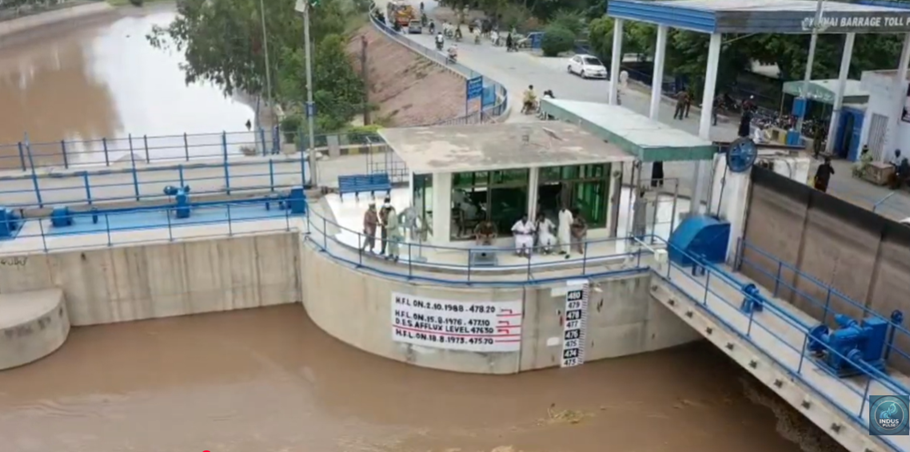
Shehzad said the removal of this Bela is a priority under the ongoing development works to improve the flow of floodwater.
He added that the Irrigation Department has formally briefed the Deputy Superintendent of Railways, Multan Division, the General Managers of the M-3 and M-4 Motorways, and the relevant Pakistan Army authorities about the obstacles restricting the river’s natural flow.
“It is now the responsibility of the concerned departments to remove these obstacles in time,” Shehzad said.
XEN at Sidhnai Headworks acknowledged that redesigning or expanding the existing Nikaso spill channel will be a long-term undertaking. However, he said the Irrigation Department is seriously examining options to improve its performance in the future.
Climate experts believe that the challenge extends beyond engineering.
Dr Shafeeq Kamboh, an expert in climate communication, said the Nikaso spill channel was built nearly 67 years ago under climate conditions that no longer exist. Today, climate change and global warming are accelerating glacier melt and increasing river flows, placing unprecedented pressure on Pakistan’s flood-control infrastructure.
Dr Kamboh noted that temperatures across the Himalayan and Hindu Kush mountain ranges have already increased significantly, leading to faster glacier melting. Since rivers are the natural pathways for this additional water, any obstruction to their flow can force rivers to create new channels, increasing the risk of flooding and destruction.
The climate communication expert argues that Pakistan’s river infrastructure can no longer be planned on the basis of historical conditions alone.
In light of climate change, changing river dynamics, and future water challenges, including those linked to the Indus river system, he says the country must reassess and modernize its flood management infrastructure to cope with the realities of a changing climate.
Dr Faisal Saleem holds a PhD in Media Studies and is a journalist and researcher. He writes on politics, climate change, environmental issues, human rights, and other public-interest issues, with a focus on evidence-based journalism.
