

Pakistan’s Multidimensional Poverty Trap
Ishtiaq Ahmed
Bradford: As Pakistan continues to grapple with internal and external security challenges, strained relations between the federal government and provincial administrations, and intensifying political acrimony, it faces an equally formidable challenge in tackling widespread poverty.
According to the United Nations Development Programme (UNDP), nearly four in every 10 Pakistanis experience multidimensional poverty, facing overlapping deprivations in health, education and living standards.
These interconnected challenges underscore the urgency of coordinated governance, political stability and sustained, inclusive development to address the country’s deep-rooted socioeconomic vulnerabilities and arrest the intensifying sense of disparities between provinces which partly explain the growing strife.
The figures reveal a development crisis. For millions of Pakistanis, poverty is not simply a question of how much money they earn, but whether they have access to education, healthcare, clean drinking water, adequate sanitation and other essentials for a dignified life.
The UNDP’s Global Multidimensional Poverty Index (MPI) 2024 estimates that 38.3 per cent of Pakistan’s population was living in multidimensional poverty, while another 12.9 per cent was vulnerable to falling into it.
Among those classified as poor, the average intensity of deprivation stood at 51.7 per cent, indicating that affected households experienced more than half of the weighted disadvantages measured by the index.
The regional comparison offers further insight into Pakistan’s development challenges. Pakistan considerably lags behind India and Bangladesh which should be a point of embarrassment for the Pakistan leadership.
Even if we acknowledge that national poverty indices use different methodologies and may produce different estimates, the Pakistan position is dire.
The disparity raises a fundamental question: why has Pakistan struggled to translate economic activity, public spending and development initiatives into broader improvements in people’s lives?
The answer lies in a combination of structural weaknesses, including educational deprivation, inadequate public services, unequal development and the vulnerability of low-income households to economic and environmental shocks.
These factors reinforce one another, creating conditions in which families struggle not only to escape poverty but also to protect themselves from falling deeper into it.
Education remains one of the most significant pressure points. There is a direct correlation between poor standards of education and economic development and sustainability. The UNDP in 2016 found that educational deprivation accounted for 42.8 per cent of overall multidimensional poverty, followed by living-standard deprivations at 31.5 per cent and health-related disadvantages at 25.7 per cent.
Within the education category, years of schooling made the largest individual contribution to the national poverty measure.
Although these figures are based on older data, they illustrate the structural nature of the problem. Educational deprivation extends beyond whether children are enrolled in school. It also concerns how long they remain in education, the quality of learning they receive and whether they acquire the skills needed to participate in a changing economy.
When children miss out on education or adults lack sufficient schooling, their households often face greater difficulties securing stable employment, improving earnings and breaking the cycle of poverty across generations.
The consequences extend beyond individual families, limiting the development of a skilled workforce and constraining the country’s long-term economic potential.
These disadvantages become more severe when combined with inadequate healthcare, unsafe drinking water, poor sanitation and unreliable electricity.
Families without access to essential services face greater health risks and additional expenses, while illness can deprive households of income and force children to miss school. In this way, individual forms of deprivation combine to produce a broader pattern of exclusion.
The World Bank has similarly identified weaknesses in education, healthcare and public services as persistent obstacles to poverty reduction in Pakistan. Its October 2025 assessment noted that progress in human capital development had lagged and that rural poverty remained more than twice the urban level.
These findings highlight the importance of addressing not only household incomes but also the public services and economic opportunities that shape people’s living conditions.
Economic instability has further undermined efforts to reduce poverty. Pakistan made substantial progress in reducing monetary poverty during the early 2000s and through 2018, but the momentum subsequently weakened as successive shocks eroded household purchasing power and disrupted employment opportunities.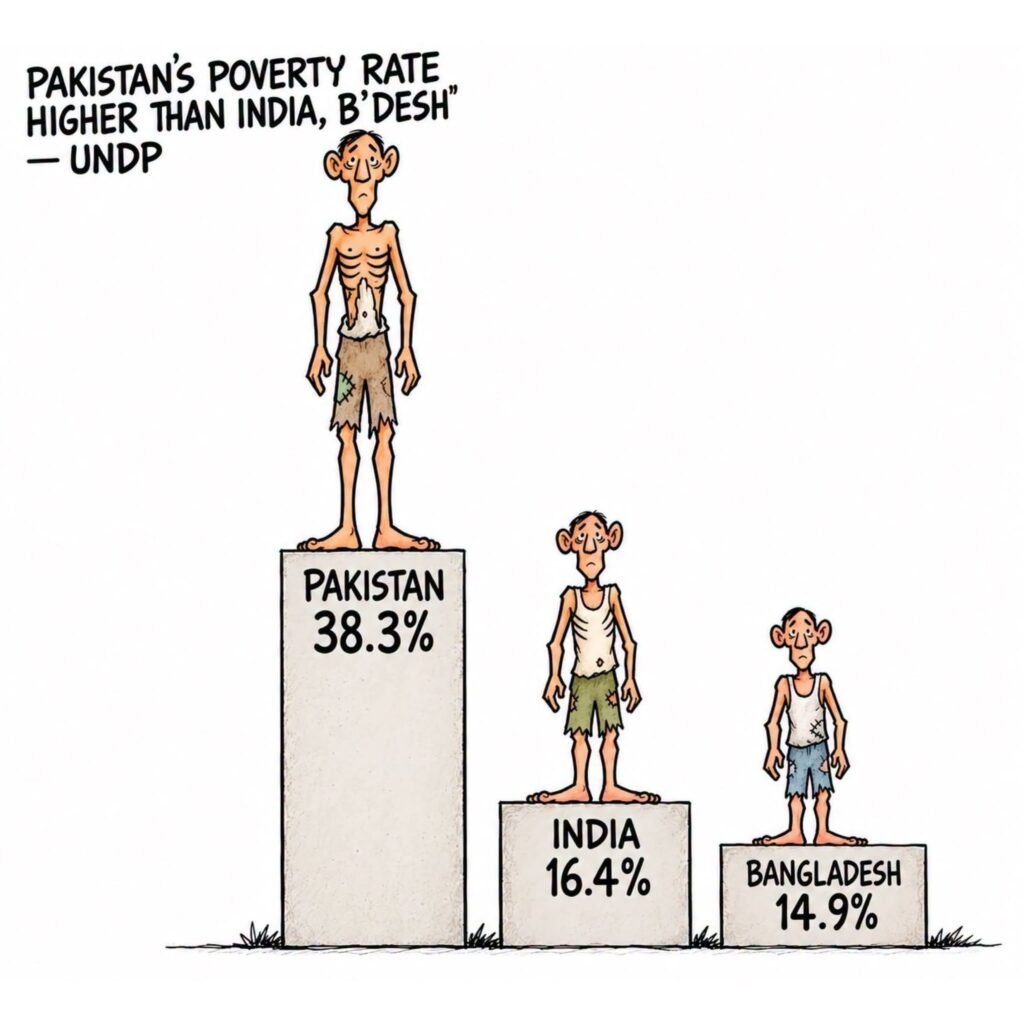 According to the World Bank’s October 2025 analysis, the Covid-19 pandemic, the devastating floods of 2022, economic instability and exceptionally high inflation contributed to the reversal of earlier poverty-reduction gains. The floods alone pushed an estimated 13 million additional Pakistanis into poverty, according to the assessment.
These shocks exposed the fragility of livelihoods that depend on low-productivity employment, informal work and weather-sensitive economic activities. When prices rise sharply or employment becomes uncertain, households with limited savings have few options for protecting their living standards.
Families may cut food consumption, postpone medical treatment, withdraw children from school or take on debt to meet essential expenses.
The effects are particularly damaging when households already experience multiple forms of deprivation. A family with inadequate housing, poor sanitation and limited access to healthcare is less equipped to withstand an economic downturn than one with stable employment, savings and access to reliable public services.
A temporary loss of income can therefore trigger a series of setbacks that deepen poverty across several dimensions simultaneously.
Climate-related disasters add another layer of vulnerability, particularly for rural communities dependent on agriculture and other weather-sensitive livelihoods. Floods can destroy homes, crops, livestock and infrastructure, leaving families without income or access to essential services.
Recovery may take years, especially where public support is limited and alternative employment opportunities are scarce. Nevertheless, the precise contribution of climate hazards to Pakistan’s current multidimensional poverty rate cannot be established from the national figures alone.
Pakistan’s experience also reflects a wider international challenge.
The UNDP’s Global Multidimensional Poverty Index 2026, released on October 12, reports that approximately 1.2 billion people across 108 countries live in acute multidimensional poverty. On a like-for-like basis, this represents an increase of 51.5 million people compared with the previous update and marks the first rise in the total number of multidimensionally poor people since the index was launched in 2010.
Children account for 617 million of those affected, while 83 per cent of people living in multidimensional poverty reside in rural areas. The findings underline the unequal distribution of deprivation and the particular vulnerability of communities that lack adequate services and economic opportunities.
For Pakistan, the challenge is to convert economic stabilisation and development spending into measurable improvements in people’s everyday lives. This requires a more comprehensive approach to poverty reduction, one that recognises the relationship between education, healthcare, employment, infrastructure and social protection.
Improving access to quality education must be a central priority. Expanding school access alone is insufficient unless children receive meaningful learning opportunities and can progress through the education system. Investment in teachers, school facilities and learning outcomes is essential, particularly in disadvantaged rural areas and communities where educational deprivation remains entrenched.
Healthcare, clean drinking water and adequate sanitation are equally important. Reliable access to these services can reduce preventable illness, ease the financial burden on low-income households and improve people’s ability to participate in education and employment. Extending essential services to underserved districts would also help address the persistent divide between rural and urban living standards.
At the same time, Pakistan needs more productive employment opportunities that allow households to earn sustainable incomes. Economic growth is less effective at reducing poverty when employment remains insecure, productivity is low and workers have limited opportunities to develop their skills.
Policies that strengthen livelihoods, improve access to skills training and expand opportunities beyond vulnerable forms of employment can help households build greater financial security.
Better-targeted social protection is another essential component of the response. Support for vulnerable households can help families maintain access to food, healthcare and education during periods of inflation, unemployment or disaster. Such programmes are particularly important when economic shocks threaten to reverse years of gradual progress.
Building resilience to climate-related disasters must also form part of a long-term poverty-reduction strategy. Investment in resilient infrastructure, disaster preparedness and livelihood diversification can help reduce the damage caused by floods and other extreme events. For rural households, greater economic security depends partly on reducing their exposure to environmental risks and improving their capacity to recover when disasters occur.
Equally important is the need for reliable and regularly updated data. Pakistan’s widely cited multidimensional poverty estimate of 38.3 per cent is based on a household survey conducted in 2017–18.
While it remains useful for understanding the scale and pattern of deprivation at that time, it should not be presented as a direct assessment of current conditions. More recent, comparable household data would allow policymakers to identify where poverty has worsened, where progress has been made and which interventions are delivering meaningful results.
The distinction between measuring poverty and explaining its causes is crucial. Together, they provide important evidence of the challenge, but they do not establish that every identified factor contributed equally to Pakistan’s multidimensional poverty rate.
Ultimately, poverty is not merely a question of household income. It is also about whether people can obtain an education, receive healthcare, access clean water and electricity, secure productive employment and live in conditions that allow them to participate fully in society. When several of these essentials are missing at once, even modest economic progress may fail to deliver meaningful improvements in people’s lives.
For Pakistan, reducing multidimensional poverty will require sustained investment in human development, stronger public services and economic opportunities that reach disadvantaged communities. It will also require policies that protect vulnerable households from economic instability and environmental disasters while ensuring that development gains are more widely shared.
The figures present a sobering picture, but they also clarify the priorities. Pakistan’s development challenge cannot be resolved through economic stabilisation alone, nor can poverty be sustainably reduced through short-term relief measures.
Lasting progress will depend on addressing the underlying conditions that keep millions of people deprived of basic opportunities and services. Without that shift, improvements in headline economic indicators may leave a substantial share of the population struggling to meet its most fundamental needs.
