

The Rain Is Falling. Can Bajaur Save It?
Shah Khalid Shah
BAJAUR: On a rainy day in Bajaur, thousands of litres of water can disappear within minutes.
It rushes down rooftops, streets and mountain slopes, gathers in drains and streams, and eventually flows away. For many communities, however, the same water that is wasted during the rainy season could become a lifeline during the dry months.
That reality is beginning to receive attention in Bajaur, where the district administration has launched a rainwater harvesting initiative aimed at turning rainfall into a source of stored water and groundwater recharge.
Deputy Commissioner Bajaur Adnan Farid Afridi, accompanied by Additional Deputy Commissioner Finance and Planning Saeed Ullah Jan, formally inaugurated a rooftop rainwater harvesting system at his office in Civil Colony Khar.
The first model system, installed on the roof of the Additional Deputy Commissioner’s office, cost around Rs600,000 and was completed under the supervision of the Public Health Engineering Division Bajaur.
Inspecting the project, the deputy commissioner described rainwater conservation as an important step towards making better use of available water resources and helping maintain groundwater levels.
The system is designed to collect rainwater and allow it to pass through a natural filtration process before helping recharge underground water reservoirs.
For the district administration, the project is intended to be more than a demonstration.
Officials plan to introduce similar systems in government buildings, including Rescue 1122 offices and tehsil complexes, before eventually encouraging their adoption in private schools and hospitals.
A district surrounded by rain and water shortages
Bajaur presents a striking contradiction.
The district receives significant rainfall, yet many communities continue to struggle with access to drinking water. In some areas, residents have to dig or deepen wells to meet their needs, while natural springs that once supplied villages have weakened or disappeared.
The problem is becoming more complicated as the population grows and new houses rapidly spread across the district.
Shah Wali Khan, a resident of Tehsil Khar, recently built a house covering more than one kanal. Yet, like many other residents, he had never considered installing a system to collect and store rainwater.
“I had not thought about storing rainwater and using it later,” Khan said, acknowledging that the practice should become part of household planning.
For him, the issue is straightforward: water sustains life, but communities have not given enough attention to protecting and storing it.
As demand for drinking water increases year after year, he believes residents must begin treating rainfall as a resource rather than something that simply disappears after a storm.
When springs disappear
For Muhammad Irshad, the consequences of water scarcity are already visible.
His house lies at the foot of the mountains, where the water level in his well has fallen considerably. Natural springs in his village have also dried up, which residents associate with changing climatic conditions.
Today, the entire village depends on a single solar-powered water supply scheme.
That dependence creates another vulnerability.
If the scheme develops a major fault, the community could immediately face a serious drinking-water shortage.
Yet despite the shortage, households in the village have not widely adopted rainwater harvesting.
Irshad believes the solution should extend beyond individual homes.
He says several locations around the village could potentially accommodate small rainwater dams. Such structures could slow down runoff, reduce damage to agricultural land and allow more water to seep into the ground.
Some sites were reportedly surveyed several years ago, he said, but no further progress followed.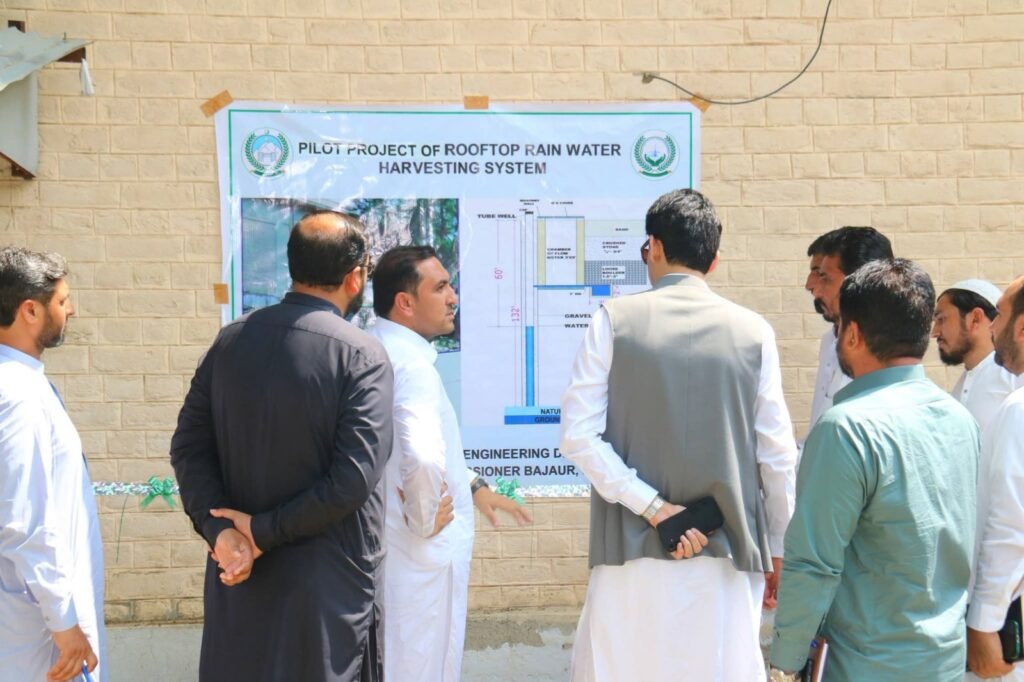 Rooftops to underground reservoirs
Rainwater harvesting is relatively simple in principle.
Instead of allowing rainwater to run into streets and drains, it is collected from rooftops and directed through pipes into storage tanks, underground reservoirs, ponds or recharge wells.
In recharge systems, filtered water is allowed to seep into the ground, helping replenish underground aquifers.
For a district such as Bajaur, where agriculture, livestock and household water supplies are closely connected to rainfall and groundwater, the approach could have several uses.
It can reduce pressure on wells and government water supplies, provide water for gardens and agricultural activities, and help slow the rapid movement of stormwater during heavy rainfall.
Small storage ponds and check dams can also capture runoff from mountainous areas and release water more gradually.
Why Bajaur has significant potential
Bajaur’s geography makes rainwater harvesting particularly relevant.
The district receives substantial rainfall, with an estimated annual average of around 800 millimetres. Rainfall occurs during the monsoon season from July to September as well as during the period influenced by western weather systems from December to March.
But much of that water is not captured.
Instead, heavy rain can quickly move down the district’s slopes and mountain channels, creating flash-flood risks while contributing little to long-term water storage.
Agriculture faces a similar challenge.
Available figures cited in the discussion of rainwater harvesting indicate that only around 27 percent of agricultural land in Bajaur is supplied by canals or tube wells, leaving much of the farming sector dependent on rainfall.
For farmers, small lined ponds near fields could provide a reserve during dry periods.
Even relatively inexpensive earthen ponds reinforced with plastic lining can store large quantities of water for later use, potentially supporting crops, gardens and orchards.
Holding back water in mountains
The district’s hills offer another opportunity.
During intense rainfall, water can move rapidly downhill, carrying soil and damaging agricultural land. Small check dams, earthen embankments and other water-retention structures can slow this runoff.
Instead of allowing the water to disappear downstream, these structures can temporarily retain it and give more time for infiltration into the soil.
That could serve two purposes at once: reducing the intensity of runoff while supporting groundwater recharge.
With groundwater levels under pressure from increasing extraction and changing rainfall patterns, recharge pits and wells could also become increasingly important.
A policy shift
The Bajaur initiative comes amid a broader push in Pakistan to promote rainwater conservation through building regulations and public-sector projects.
The federal government has approved provisions for rainwater harvesting in the Building Code of Pakistan, while authorities in Islamabad and Punjab have introduced measures aimed at encouraging or requiring water-conservation systems in specified buildings and sectors.
In Khyber Pakhtunkhwa, the government has directed departments to implement rainwater harvesting systems in public buildings, including schools, hospitals and offices.
The model project in Khar is therefore being presented not simply as a single installation, but as a possible example for wider adoption.
The cost of doing nothing
According to Shahzad Khan, XEN of the Public Health Engineering Department in Bajaur, rainwater harvesting can broadly be implemented through two approaches.
The first involves collecting water from rooftops and directing it into underground tanks.
The second involves constructing small dams or retention structures near the foothills to capture runoff from mountainous areas.
In urban areas, where houses may have limited space, even drums and smaller storage containers can be used to collect rainwater.
Khan estimates that a household rainwater harvesting system can cost between Rs60,000 and Rs100,000, depending on its design and scale.
He argues that despite the initial expense, the system can provide a long-term response to water shortages.
The Public Health Engineering Department, he added, is prepared to provide technical guidance to residents who want to install such systems.
From one roof to an entire community
The challenge facing Bajaur is not simply a shortage of water.
It is also a shortage of awareness about how existing water can be captured, stored and reused.
For decades, rain has largely been treated as something that arrives, runs off the mountains and disappears.
That mindset may have to change.
Shah Wali Khan now says he intends to install a rainwater harvesting system at his own home and encourage others in the area to do the same.
His argument is that individual households can become part of a larger solution.
Irshad, meanwhile, wants the government to launch awareness campaigns and explore the construction of small dams in suitable mountainous areas.
For communities already watching wells fall and springs disappear, the question is no longer whether rainwater can be useful.
It is whether Bajaur can capture enough of it before it is gone.
The rooftop system inaugurated in Khar may be only one installation, but its significance lies in the possibility of changing how the district thinks about rainfall.
In a region where water shortages are becoming an increasingly visible threat, every roof, field and mountain stream could represent an opportunity to save another drop.
