
Pakistan Beyond Left and Right
Sher Ahmed Durrani
Islamabad: Pakistani politics is often described through a tired and misleading binary: religious fundamentalism versus liberal excess. This framing may be convenient, but it is deeply inaccurate.
More importantly, it impoverishes public debate by flattening a complex ideological landscape into caricatures that prevent meaningful dialogue.
Survey data tells a very different story. Research conducted by the Pakistan Institute of Development Economics (PIDE) in 2024 shows that nearly 67 per cent of Pakistanis do not identify with ideological extremes.
Instead, they place themselves at various points across a broad and fluid spectrum. Yet public discourse continues to trade in false equivalences and simplistic labels.
This reductionist habit reflects a misunderstanding of how political thought actually functions in Pakistan.
One particularly persistent myth is the idea that moderation is inherently virtuous and that truth lies somewhere in the middle of two opposing positions. This “golden mean” logic is rhetorically appealing but intellectually unsound. 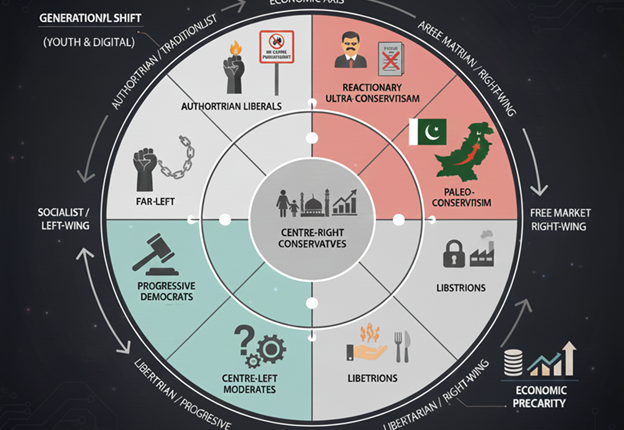 The midpoint between a right position and a wrong one is not necessarily correct; it is merely a compromise. Elevating centrism as a moral principle substitutes comfort for clarity.
Pakistani public opinion itself undermines this false binary. According to the 2024 Global Attitudes Survey by the Pew Research Center, 73 per cent of Pakistanis believe religion should play an important role in government, while 61 per cent simultaneously support democratic values and personal freedoms.
These views are not contradictory. They reflect a society negotiating complex moral and political realities rather than choosing between mutually exclusive camps.
Even conservatism in Pakistan is far from unified. Reactionary ultra-conservatism operates largely through institutional politics, media platforms, and religious organizations, often promoting agendas that clash with constitutional norms.
Statements issued over the years by the Council of Islamic Ideology illustrate this tendency, though such positions are increasingly contested by the public.
Alongside this exists a form of paleo-conservatism that combines religious traditionalism with hyper-nationalism. This strand is vocally selective in its moral outrage—raising its voice over Kashmir, Palestine, or the Rohingya crisis—while remaining largely silent on sectarian violence at home.
In 2023 alone, terrorism claimed 245 lives in Pakistan, yet domestic suffering is frequently eclipsed by external grievances.
The largest conservative bloc, however, consists of center-right voters who are religious in personal practice but pragmatic in political expectations. Gallup’s 2024 survey places this group at roughly 45 per cent of the electorate. They are conservative without being coercive—a reality rarely acknowledged in polarized commentary.
Read More: https://thepenpk.com/heart-of-asia-reimagined/
Liberalism, too, is internally diverse. Centre-left moderates often hold seemingly inconsistent positions, supporting some rights-based causes while remaining ambivalent on others. This is not hypocrisy but the lived experience of people navigating moral complexity without rigid ideological frameworks.
Libertarians in Pakistan occupy a similarly hybrid space, defending individual freedoms while endorsing strong state authority on security matters. Progressive democrats, by contrast, place human rights and due process above nationalist sentiment, often at great personal risk. Their work is documented extensively in reports by the Human Rights Commission of Pakistan.
Read More: https://thepenpk.com/dont-bomb-the-bomb/
At the margins, the far left continues to offer structural critiques of state power, particularly on civil liberties and military policy. Their opposition to capital punishment—147 executions were carried out in 2023—places them firmly outside mainstream opinion. Meanwhile, authoritarian liberals present another paradox: a belief that progressive values can be imposed through illiberal means, a legacy visible in parts of the Musharraf-era doctrine of “enlightened moderation.”
Economic reality further complicates ideological identity. With inflation reaching nearly 30 per cent in 2023–24 and the poorest 40 per cent of Pakistanis spending most of their income on food, ideological consistency often collapses under material pressure. Survival frequently trumps theory.
Generational change is also reshaping political identities. With 64 per cent of the population under the age of 30, digital natives are constructing hybrid worldviews influenced by global discourse, resisting neat ideological categorization altogether.
Read More: https://thepenpk.com/balochistans-silent-poverty-crisis/
Binary thinking—you are either with us or against us—benefits only those who thrive on polarization. Pakistan’s ideological terrain is multidimensional. Individuals hold overlapping, sometimes contradictory positions and shift their priorities depending on the issue at hand.
Political maturity requires abandoning the comfort of stereotypes. It requires recognizing that disagreement does not imply enmity, and that shared values can coexist with genuine differences. The hostility born of confusion fades when complexity is acknowledged.
Pakistan’s future does not lie in manufacturing a false center. It lies in creating space for honest engagement across a spectrum far richer than the one our public discourse currently allows.
Sher Ahmed Durrani is a senior lecturer in Political Science at the University of Loralai, Pakistan, and a PhD candidate at Quaid-i-Azam University. His research focuses on socio-political systems and sustainable development in South Asia. He can be reached at sherahmed.durrani@gmail.com.
The article is the writer’s opinion, it may or may not adhere to the organization’s editorial policy.

Comments are closed.