
Iran Acknowledges Pakistan’s Support in US-Israel Conflict
News Desk
Tehran: Amid the escalating conflict involving Iran, the United States and Israel, Iranian Foreign Minister Abbas Araghchi has expressed gratitude to Pakistan for standing in solidarity with Tehran during the ongoing crisis.
In a message posted on the social media platform X, Araghchi thanked the government and people of Pakistan for their support as Iran confronts what it described as aggression by the US and Israel.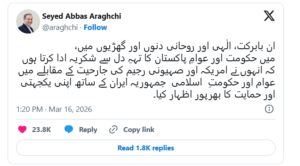 Writing in Urdu, the Iranian foreign minister said the Islamic Republic remained determined to defend its sovereignty and territorial integrity, adding that Iran was relying on faith and resilience during what he called “blessed and spiritual days.”
Araghchi said the solidarity expressed by Pakistan reflected strong support for Iran and its people at a time of heightened tensions in the Middle East.
The statement comes as the conflict between Iran and its adversaries intensifies following US and Israeli strikes on Iranian targets on February 28. Tehran has since retaliated with missile and drone attacks on US military installations across the Gulf region.
Pakistan has urged restraint and diplomacy amid the crisis. Speaking in the Senate earlier this month, Deputy Prime Minister and Foreign Minister Ishaq Dar said Islamabad had offered to facilitate dialogue between Tehran and Washington to help end the violence.
Dar said Iran had indicated its willingness not to develop nuclear weapons, but the United States was pushing for the complete dismantling of Tehran’s nuclear programme. He said Pakistan supported Iran’s right to use nuclear energy for peaceful purposes.
He added that while Pakistan stands with Iran, it does not wish to become part of a wider regional conflict.
The confrontation has entered its third week, sending shockwaves across global energy markets and raising concerns about maritime security in the Gulf.
Former US president Donald Trump recently urged countries dependent on Gulf oil to help secure the strategic waterway of the Strait of Hormuz, through which nearly 20 percent of the world’s energy supplies pass.
However, key allies including Japan and Australia have reportedly declined to send naval vessels to escort ships in the region.
Meanwhile, explosions were reported in Tehran on Monday, with air defence systems activated across the capital following what Israel described as large-scale overnight strikes. The exact targets of the blasts were not immediately confirmed.
