
Forgotten on the Margins: Living with Disability in Bajaur
Shah Khalid Shah Jee
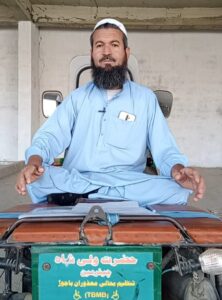
Bajaur: Rehanullah, a 26-year-old resident of Bajaur Tribal District, navigates the dusty roads on his three-wheeler bike to reach the office of Hazrat Wali Shah, chairman of the Tanzemi Bahali Mazooran Bajaur (TBMB) organization.
Rehan, who suffered a spinal cord injury twelve years ago while studying in eighth grade, is half-paralyzed and dependent on assistance for mobility. Today, he carries an application seeking help to overcome the daily challenges of living with a disability.
“Since the accident, I have been living as a disabled person. I spent years in bed, but I knew I needed skills to survive independently,” Rehan recounts. “I approached Hazrat Wali Shah to learn tailoring.
He admitted me to a center near College Farsh, where I began my training. I would travel in a wheelchair with my younger brother’s help, but even a short journey to the center was painful due to the long roads.”
The closure of this tailoring center due to financial constraints shattered Rehan’s hopes. “If I had learned tailoring, I could have earned a living and not been a burden on my family. Today, life is extremely difficult, especially in this era of rising inflation,” he says.
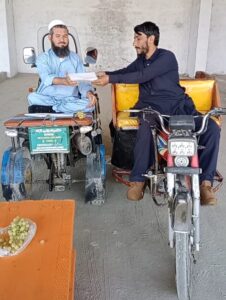
Rehan’s story is far from unique in Bajaur. Ziaur Rehman, 22, who is disabled in both legs due to a childhood illness, faces similar hardships. Using a tricycle to move around, Zia was forced to leave school and now lives in constant struggle.
“I came here to New Khan vegetable market on a punctured tricycle tire just to share my problem with Hazrat Wali Shah,” he explains. “Whenever I face difficulties, he helps within his capacity, but we cannot rely on others forever.”

According to the Directorate of Social Welfare, Zakat, and Ushr, there are 46,701 registered persons with disabilities across the merged districts of Pakistan.
In Bajaur, with a population of over 1.2 million, the Social Welfare Department lists 10,000 registered special persons, while TBMB estimates the number at 12,500—likely higher due to unregistered cases in remote areas.
To address these challenges, the provincial government in 2018 proposed the construction of a Special Education Complex at Haji Lawang on the Bajaur-Munda highway, five kilometers from Khar, with 30 kanals of land and an approved budget of Rs 220 million.
Despite the announcement, seven years have passed with no practical work initiated, leaving the disabled population in Bajaur struggling with education, skills training, and daily survival.
Read More: https://thepenpk.com/study-uncovers-gender-disparities-in-disability-insignia-cnic-issuance/
Hazrat Wali Shah, TBMB chairman, emphasizes the critical need for this complex. “We have no permanent office; I can only meet people once a week at Khan Sabzi Mandi in Khar. If the Special Education Complex had been built on time, many of these problems could have been avoided,” he says.
Over the years, Wali Shah established a tailoring center, training over 400 people, and distributed wheelchairs, white canes, and hearing aids. He also facilitated financial assistance through philanthropists for employment.
“When the provincial government approved the Special Education Complex in 2018, with an initial Rs 110 million, it was a hopeful moment. Later, the budget was doubled to Rs 220 million under Minister Anwar Zeb Khan, who promised its completion. Yet the project remains stalled,” he laments.
Burhan Salarzai, Acting District Director of Social Welfare in Bajaur, cites land acquisition issues in Mohmand and Khyber districts as reasons for the stalled Accelerated Implementation Program (AIP) project.
Despite setbacks, the Social Welfare Department continues to coordinate with elected representatives to secure funds and facilitate construction.
Meanwhile, Bajaur has a functioning school for the dumb, deaf, and visually impaired, providing free education. Yet, the absence of the promised Special Education Complex leaves a significant gap in skills training and educational opportunities.
Wali Shah appeals to local authorities and elected representatives: “Work on the Special Education Complex must start immediately. I will not rest until the special persons of Bajaur receive their rightful facilities. Their rights cannot be ignored, and allocated funds must not be misused.”
Read More: https://thepenpk.com/hiv-patients-surge-services-suspended-in-kps-merged-areas/
For Rehan, Zia, and thousands of others, the delay represents lost opportunities, unfulfilled potential, and a struggle to live with dignity. The Special Education Complex, if realized, promises not only education and skill-building but also the chance for independence and respect in a society that has long overlooked them.

Comments are closed.