
Fashion, Politics, and Bold Statements by Usman Malik
Kashaf Ali
Lahore: Every outfit he wears is a simple question: does masculinity have to look only one way?
Fashion in South Asia has always been more than fabric. It can praise you or punish you, signal respectability or provoke judgement.
In Pakistan especially, where men and women grow up inside quiet but rigid expectations, clothing becomes a silent rulebook. Most people follow it. A few don’t and that’s where Muhammad Usman Malik walks in.
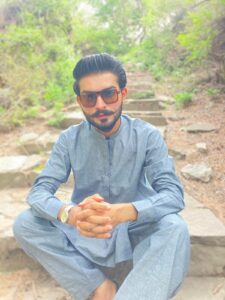
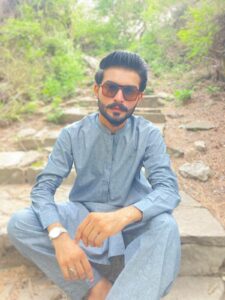
Malik isn’t a mainstream superstar yet, but he has managed to stir a conversation many avoid. His wardrobe alone raises eyebrows: long, fluid silhouettes one day, sharp metallic textures the next, colours that men here are rarely encouraged to wear. Instead of dressing to blend in, he seems to be asking, Why should men dress one way forever? Who decided that?
On screen, he gravitates toward characters with softness, hesitation, interior conflict, the kind of male emotions Pakistani television still treats carefully.
Off screen, his clothes speak the same language. They feel like a refusal to shrink into a safe version of masculinity. He dresses with a kind of quiet audacity, not for shock value, but because it feels like him.
That became impossible to ignore earlier this year, when he shot an international inner-wear campaign for a global fashion label. The visuals were close, raw, body-forward the kind of imagery usually reserved for Western men who are allowed sensuality without scandal.
Here, the internet split instantly. Some applauded him: finally, a Pakistani man unafraid of his own skin. Others declared it indecent, un-Pakistani, and disrespectful. The divide was loud, and telling.
People compared the shoot to Ranveer Singh’s bold Paper Magazine spread a reminder that across South Asia, the idea of a man being vulnerable, sensual, or simply styled differently still unsettles many.
What Malik did wasn’t just a photo-op. It poked the fence that keeps male expression fenced in.
And that is where this stops being just a fashion story.
Because when society tells men what they can’t wear, how they should look, where they must draw the line it’s no longer about aesthetics. It becomes a question of freedom.
If clothes are allowed to decide dignity or shame, then self-presentation becomes a human-rights issue.
Malik’s style challenges the quiet policing men face daily: don’t wear pink, don’t stand out, don’t look “too much.” He steps over that line and simply keeps walking.
His clothing might be bold, but the idea under it is simple: a man should get to be who he is, without apology, without mockery, without being told he has crossed a boundary no one remembers agreeing to.
Malik’s fashion does not ask for permission; it opens space. Space for softness in men. Space for colour. Space for individuality.
And maybe that is what unsettles people most: the possibility that more men might claim that space too.

Comments are closed.